

Duluth Car Accident Lawyer – Free Consultation
Table of Contents

If you’ve been injured in a car accident in Duluth, Georgia, you’re likely dealing with pain, stress, and uncertainty about what comes next. The days after a serious crash can feel overwhelming – medical appointments, missed work, calls from insurance adjusters, and decisions that need to be made before you’ve even had a chance to process what happened.
What does a Duluth, GA car accident lawyer do?
A Duluth, Georgia car accident lawyer investigates your crash, gathers evidence, handles insurance negotiations, and works to recover maximum compensation for your medical bills, lost wages, and pain and suffering.
Scholle Law helps accident victims in Duluth and throughout Gwinnett County recover the compensation they need to move forward – covering medical bills, lost income, vehicle damage, and the full impact this injury has had on your life and the lives of people who depend on you.
We handle the insurance companies so you don’t have to. Call today for a free consultation. No fee unless we win.
Why Choose a Duluth, Georgia Car Accident Lawyer
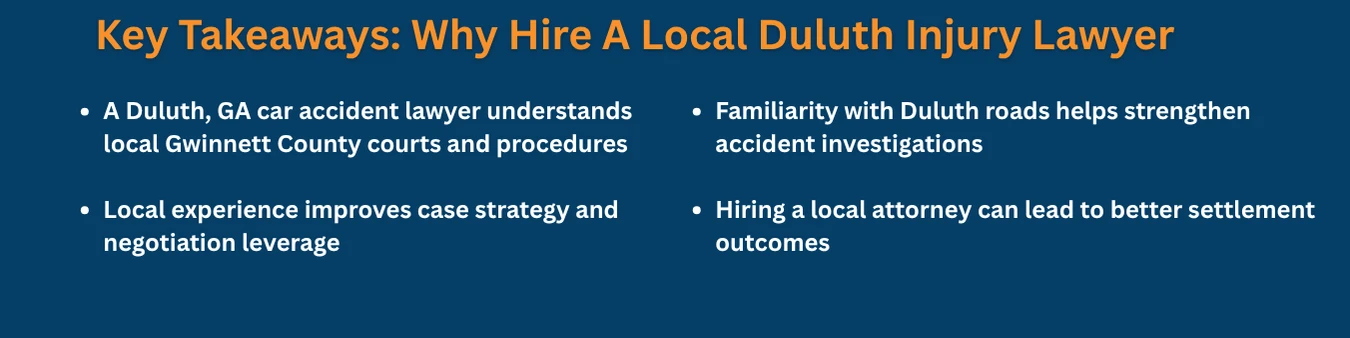
Why hire a local Duluth, Georgia car accident lawyer?
A local Duluth, GA lawyer understands Gwinnett County courts, local accident patterns, and regional insurance tactics, which helps build stronger cases and improves settlement outcomes.
Not all car accident lawyers are the same. Choosing a personal injury law firm with deep roots in Gwinnett County – one who has handled cases in local courts, negotiated with regional insurance adjusters, and understands the specific roads and intersections where crashes occur – can make a meaningful difference in your outcome.
Local Experience in Gwinnett County Courts
Duluth sits in Gwinnett County, one of the most densely populated counties in Georgia and one of the fastest-growing in the entire Southeast. With that growth comes traffic – and with that traffic comes accidents.
We know how cases move through Gwinnett County courts. We know the local procedures, the judges, and how insurance companies operating in this region tend to approach claims. That knowledge isn’t abstract – it shapes how we build your case, what evidence we gather, and how we negotiate on your behalf.
We’re also familiar with the specific roads where accidents happen most frequently in Duluth and the surrounding areas:
- Peachtree Industrial Boulevard – A high-traffic commercial corridor with frequent rear-end and lane-change collisions
- Buford Highway – Known for aggressive driving, distracted driving, and higher-speed crashes
- Pleasant Hill Road – Heavy commuter traffic and numerous intersection accidents
- Steve Reynolds Boulevard – A growing hot spot as residential development increases surrounding traffic
- Satellite Boulevard – Congested interchange areas with frequent fender-benders and serious crashes alike
When your lawyer already knows these roads – their speed limits, their traffic patterns, their history of accidents – they can more effectively investigate your crash, identify contributing factors, and build a compelling case.
Proven Personal Injury Law Case Results
Insurance companies evaluate how likely a law firm is to actually go to trial. When they know they’re dealing with a firm that has a track record of verdicts – not just settlements – they take cases more seriously.
Scholle Law has recovered over $100 million for injured clients across Georgia. With more 3 decades of experience handling personal injury and car accident claims, we’ve seen virtually every type of case, every insurance company tactic, and every argument used to reduce or deny claims.
We’re always prepared to take a case to trial if that’s what it takes to get you what you deserve.
No Fee Until You Win
You don’t pay anything to get started – and you never pay out of pocket for our services.
- No hourly fees
- No upfront retainer
- No hidden costs
We work on a contingency fee basis, which means we only get paid when we recover money for you. Our fee comes as a percentage of your settlement or verdict, so you can pursue your claim without financial risk.
This allows you to focus on healing while we handle everything else.
We represent injured drivers and passengers across Duluth and throughout Gwinnett County. Our team helps people hurt in crashes near Downtown Duluth, along the busy Gas South Arena corridor, and on some of the area’s most heavily traveled roads, including Interstate 85, Georgia State Route 120, Pleasant Hill Road, and Satellite Boulevard. These roads connect Duluth to nearby communities like Suwanee, Norcross, Johns Creek, Lawrenceville, and Buford, and they see steady traffic every day.
Whether your accident happened at an I-85 interchange, while heading through Downtown Duluth, or near the businesses and shopping centers along Pleasant Hill Road or Satellite Boulevard, you deserve answers and support you can trust. Scholle Law helps injured people across Duluth and Gwinnett County hold the insurance company accountable while you focus on getting medical care and moving forward. We know how disruptive a crash can be, and we’re here to help you take back control with experienced legal guidance and family-level care from start to finish.
What to Do After a Car Accident in Duluth, GA
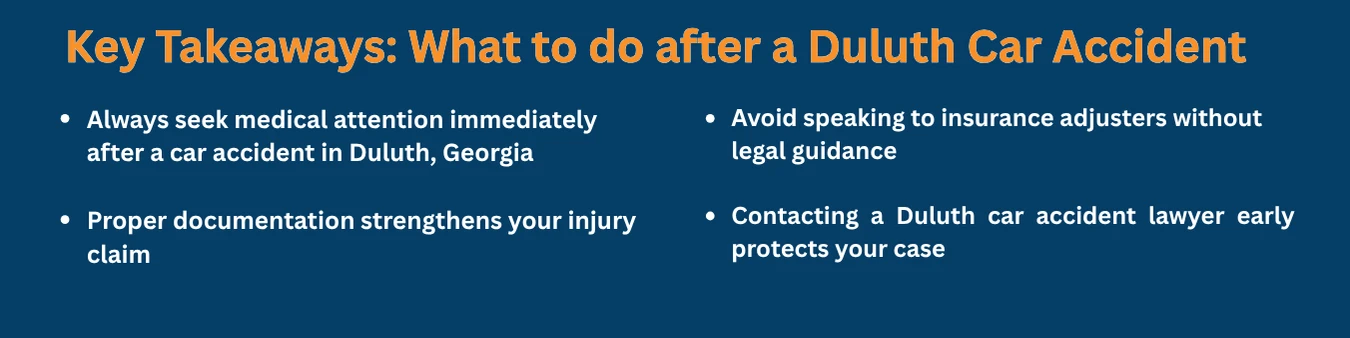
What should I do immediately after a car accident in Duluth, GA?
Quick answer:
- Call 911
- Seek medical care
- Photograph vehicles/injuries
- Exchange insurance info
- Avoid recorded statements
- Contact a Duluth car accident lawyer
After a car accident in Duluth, Georgia, call 911, seek medical care, document the scene, avoid speaking with insurance adjusters, and contact a car accident lawyer as soon as possible.
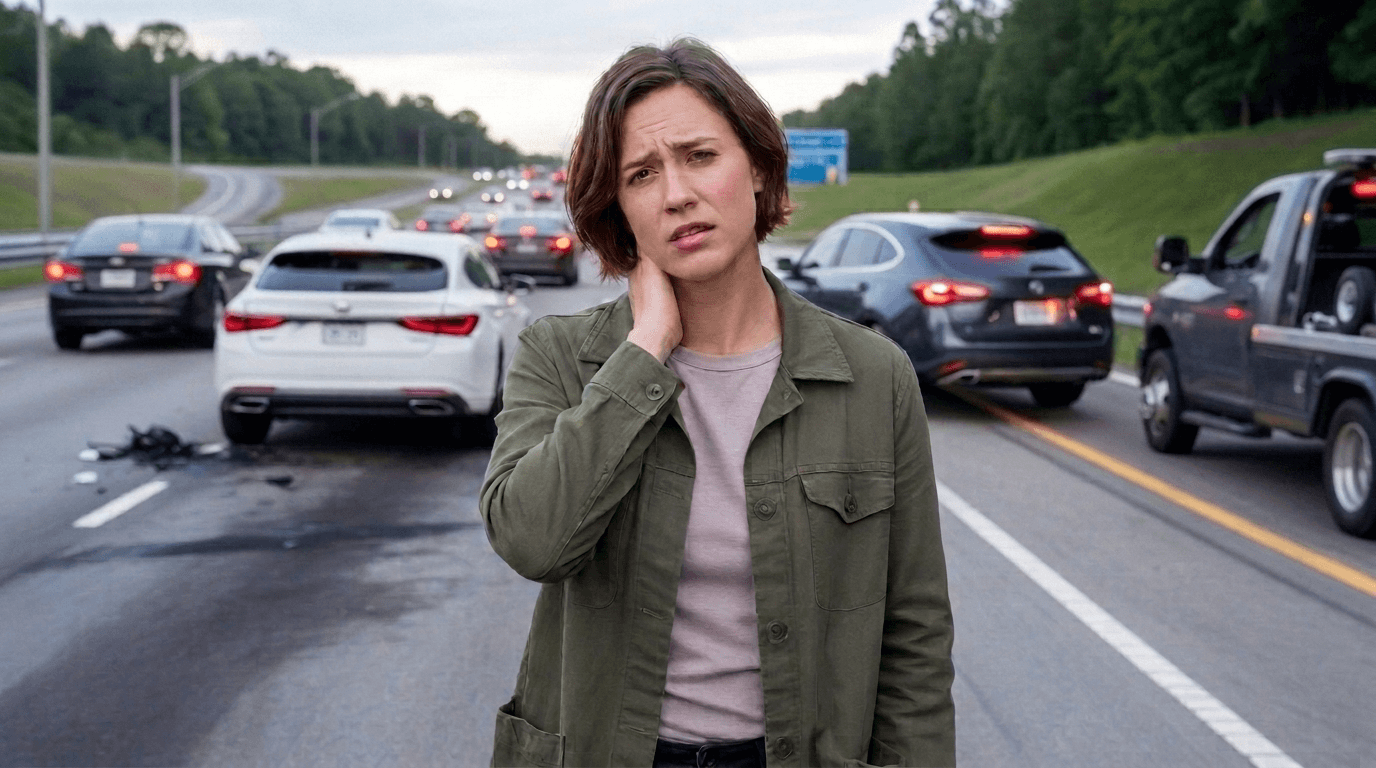
Step 1: Call 911 and Seek Medical Attention
Do I need medical treatment after a minor accident?
Yes. Many injuries, including whiplash and internal trauma, may not show symptoms immediately. Medical documentation is critical for both your health and your legal claim.
Your health is the top priority. Even if you feel okay at the scene, many serious injuries — including traumatic brain injuries, internal bleeding, soft tissue damage, and spinal injuries — don’t produce obvious symptoms right away. Adrenaline masks pain. Symptoms can develop or worsen over the following 24 to 72 hours.
Calling 911 creates an official police report, which becomes one of the most important documents in your case. It establishes the basic facts of the accident: who was involved, where it happened, what the officers observed, and whether any citations were issued.
Go to the emergency room or urgent care even if your injuries seem minor. Follow-up with your primary care physician and any specialists your doctor recommends. A gap in medical treatment is one of the most common arguments insurance companies use to minimize claims.
Step 2: Document the Scene
If you’re physically able to do so safely, document everything before leaving the scene:
- Photos of all vehicles involved – including damage, position on the road, and license plates
- Photos of your injuries – visible cuts, bruising, or swelling
- Photos of the surrounding area – traffic signals, road conditions, skid marks, debris
- Contact information for all witnesses – names and phone numbers
- The other driver’s information – license, insurance card, registration
Video is even better than photos. A 30-second walkthrough of the scene captures details a single frame might miss.
Step 3: Avoid Speaking to Insurance Adjusters
The other driver’s insurance company may contact you within hours of the accident. They will be friendly. They will express concern for your wellbeing. They may make an early settlement offer.
Don’t accept it. Don’t give a recorded statement. Don’t discuss the details of your injuries or what you believe caused the accident.
Insurance adjusters are trained to gather information that can be used to reduce your claim. Anything you say — even something as innocent as “I’m doing okay” – can be used against you. Your words are not protected the way they would be in a conversation with your attorney.
Politely tell them you are working with a lawyer and that they should direct their communications there.
Step 4: Contact a Duluth Car Accident Law Firm Immediately
The sooner you have legal representation, the better position you’ll be in. Evidence disappears. Witnesses become harder to reach. Surveillance footage gets overwritten. The insurance company has been building their case from the moment the accident was reported – your attorney needs to start building yours.
An experienced Gwinnett County car accident lawyer can advise you on every decision, communicate with insurance companies on your behalf, and ensure nothing you do inadvertently hurts your claim.
Common Causes of Car Accidents in Duluth, Georgia
What is the most common cause of car accidents in Duluth, GA?
Distracted driving is the leading cause of car accidents in Duluth, Georgia, followed by speeding, reckless driving, and driving under the influence.
Why are there so many car accidents in the Duluth, GA area?
Most crashes in Gwinnett County are caused by preventable driver behavior – not mechanical failures or freak weather events. Understanding the cause of your accident is central to establishing liability and maximizing your recovery.
Distracted Driving
Distracted driving is the leading cause of accidents in Georgia and across the country. In a region as busy as Duluth – with dense commercial corridors and commuters constantly on the move – distractions are everywhere.
The most dangerous distraction is cell phone use. Georgia’s hands-free law prohibits drivers from holding or supporting a phone while driving, but enforcement is inconsistent and violations are common. A driver glancing at a text message for just five seconds while traveling at highway speed covers the length of a football field with their eyes closed.
Common distraction-related accident zones in Duluth include:
- Peachtree Industrial Boulevard near the I-285 interchange
- Buford Highway at major retail and restaurant areas
- Pleasant Hill Road during peak commuter hours
When distracted driving caused your accident, your attorney can work to preserve evidence from the other driver’s phone – call records, text timestamps, app usage data – to support your case.
Speeding and Reckless Driving
How does speeding affect accident claims?
Speeding increases liability and can lead to higher compensation, especially when it contributes to severe injuries or demonstrates reckless behavior.
Speed limits in the Duluth area range from 25 mph in residential neighborhoods to 65 mph on stretches of major roads – but many drivers treat those limits as suggestions. Speeding reduces a driver’s ability to react to sudden changes in traffic, increases stopping distances, and dramatically increases the severity of impact.
Aggressive driving behaviors are common in the Atlanta metro area and frequently contribute to crashes:
- Weaving between lanes
- Tailgating
- Running red lights or stop signs
- Cutting off other vehicles
In cases involving reckless driving, there may be grounds to pursue punitive damages beyond standard compensation – particularly if the driver has a history of similar behavior.
DUI Accidents
Driving under the influence of alcohol or drugs is a serious problem in every Georgia county. DUI crashes often result in catastrophic injuries or fatalities because impaired drivers frequently fail to brake, swerve, or take any evasive action before impact.
If a drunk or drugged driver caused your accident, you have the right to pursue both compensatory damages (for your actual losses) and punitive damages (to punish the driver’s conduct and deter future behavior). Georgia courts take DUI cases seriously, and a criminal conviction against the other driver can significantly strengthen your civil claim.
Rear-End Collisions
Rear-end accidents are the most common type of crash in Duluth and throughout Gwinnett County, largely because of stop-and-go traffic patterns on commercial corridors and at busy intersections.
While rear-end collisions are often dismissed as minor fender-benders, the forces involved can cause significant injuries – particularly to the neck and spine. Whiplash, herniated discs, and cervical strain can produce chronic pain and limited range of motion that affects every aspect of daily life.
In Georgia, rear-end collisions typically result in a presumption of fault against the trailing driver. However, insurance companies still look for ways to reduce claims – arguing that the front driver stopped suddenly, that injuries are pre-existing, or that treatment was excessive.
Intersection Accidents
T-bone and angle collisions at intersections are among the most dangerous crashes in Gwinnett County. They occur most frequently where:
- Traffic signals are poorly timed or obstructed
- Drivers run red lights or fail to yield
- Poor visibility limits sight lines at cross-streets
Duluth intersections with notably high accident histories include the Pleasant Hill Road corridor, State Bridge Road at Peachtree Industrial, and various signal-controlled intersections along Buford Highway.

Types of Cases our Duluth Car Accident Attorneys Handle
What types of car accident cases do lawyers handle in Duluth, GA?
Our Duluth car accident lawyers at Scholle Law handle rear-end collisions, T-bone accidents, hit-and-run cases, rideshare accidents, truck crashes, and other injury-related vehicle claims.
Rear-End Collisions
Often dismissed as minor - but they can cause lasting neck and spine injuries that require months of treatment and physical therapy. We fight to ensure the full cost of that care is covered.
T-Bone and Angle Impact Accidents
Side-impact crashes expose vehicle occupants to significant force with limited structural protection. These crashes commonly cause rib fractures, hip injuries, internal organ damage, and head trauma.
Head-On Collisions
Among the most dangerous crash types. Head-on accidents typically occur when a driver crosses a center line, drives the wrong way on a divided roadway, or loses control around a curve. Injuries are frequently severe or fatal.
Hit and Run Accidents
Georgia law requires drivers to stop and exchange information after an accident. When the at-fault driver flees, victims feel abandoned - but legal options still exist. Your own uninsured motorist (UM) coverage may apply, and law enforcement and our investigative team can work to identify the responsible driver.
Uber and Lyft Accidents
Rideshare accidents are uniquely complex. Uber and Lyft maintain insurance policies that kick in under specific conditions based on the driver's status at the time of the crash (offline, waiting for a ride request, or actively transporting a passenger). Navigating these layered policies requires experience with both Georgia personal injury law and the specific insurance structures maintained by rideshare companies.
Truck and Commercial Vehicle Accidents
Accidents involving 18-wheelers, delivery trucks, and commercial vehicles often result in catastrophic injuries due to the size and weight differential. These cases also involve multiple potentially liable parties - the driver, the trucking company, the cargo loader, maintenance contractors - and are governed by federal regulations in addition to state law.
Motorcycle Accidents
Motorcyclists are among the most vulnerable road users. Bias against riders is common in insurance negotiations, and our team works to combat that bias with evidence-focused case building that reflects the true liability of the at-fault party.
Pedestrian and Bicycle Accidents
Pedestrians and cyclists struck by vehicles in Duluth are entitled to pursue full compensation from the at-fault driver's insurance - and in some cases, from multiple parties. These cases often involve severe orthopedic injuries, traumatic brain injuries, and long recovery timelines.

Compensation Available in Georgia Car Accident Claims
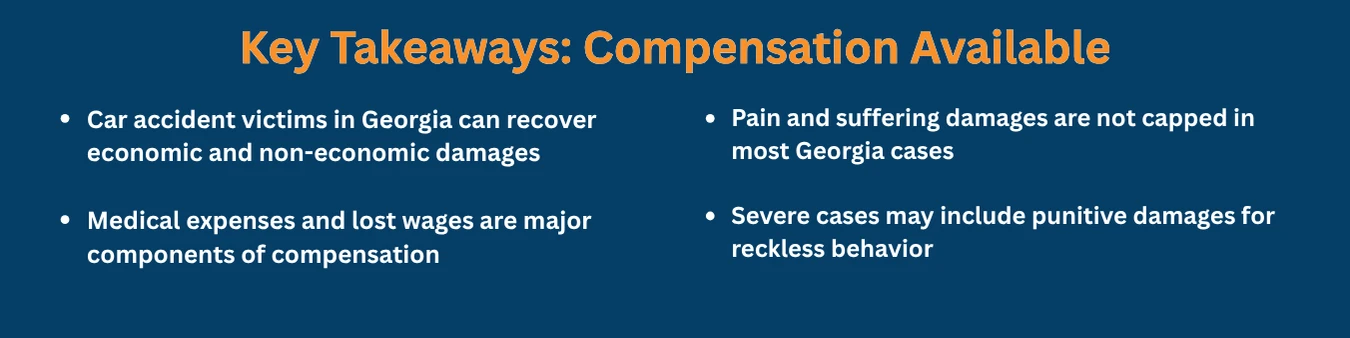
What can you recover after a car accident in Georgia?
Georgia law allows injured victims to pursue several categories of damages depending on the nature and severity of their injuries, the impact on their daily life, and the conduct of the at-fault party.
Medical Expenses
You are entitled to compensation for all reasonable and necessary medical treatment related to your injuries, including:
- Emergency room care and ambulance transport
- Hospitalization and surgical procedures
- Diagnostic imaging (X-rays, MRI, CT scans)
- Specialist visits and consultations
- Physical therapy and chiropractic care
- Prescription medications
- Assistive devices (braces, crutches, wheelchair)
- Future medical care if ongoing treatment is needed
Medical bills add up quickly. A serious injury can generate tens or hundreds of thousands of dollars in treatment costs. We work with medical experts and life care planners to ensure your full treatment needs – including future costs – are properly documented and included in your claim.
Lost Wages and Loss of Earning Capacity
If your injuries prevented you from working, you can recover the income you lost during your recovery. This includes:
- Salary, hourly wages, tips, commissions, and bonuses
- Self-employment income
- Vacation or sick time used because of the accident
If your injuries are severe enough to affect your ability to work in the future – whether you need to change careers, reduce your hours, or can no longer perform your job duties – you may also be entitled to compensation for loss of future earning capacity. This calculation considers your age, occupation, education, pre-injury earnings, and the likely trajectory of your career.
Pain and Suffering
Not every harm from a car accident shows up on a medical bill. Pain and suffering damages are intended to compensate you for the non-economic impact of your injuries:
- Physical pain during recovery and beyond
- Emotional distress and anxiety
- Sleep disruption and fatigue
- Loss of enjoyment of activities you previously valued
- Impact on your relationships and family life
- Depression or post-traumatic stress related to the accident
These damages are real, and they matter. Georgia law does not cap pain and suffering damages in standard car accident cases, which means your recovery isn’t artificially limited.
Property Damage
Compensation for vehicle repair or replacement, as well as any personal property damaged in the crash (electronics, child car seats, etc.).
Loss of Consortium
In cases involving severe injuries, a spouse may be entitled to compensation for the loss of companionship, affection, and support that results from the victim’s injuries.
Punitive Damages
In cases involving especially egregious conduct – drunk driving, street racing, extreme recklessness – Georgia courts may award punitive damages beyond compensatory damages. These are designed to punish the wrongdoer and deter similar behavior. Under Georgia law, punitive damages in most personal injury cases are capped at $250,000, with exceptions for cases involving DUI or intentional conduct.
How Much Is My Duluth Car Accident Case Worth?
What compensation can I recover after a car accident in Georgia?
You may recover compensation for medical expenses, lost wages, pain and suffering, property damage, and in some cases, punitive damages.
How is a car accident fair compensation calculated?
There’s no formula that applies to every case. Value is determined by the specific facts – and it often takes time to fully assess those facts, particularly when injuries are still being treated.
Key factors that affect case value include:
Injury severity and permanence – A broken arm that heals in six weeks is valued differently than a spinal cord injury with permanent limitations. The more serious and lasting the injury, the greater the potential recovery.
Total medical costs – Both what you’ve already spent and what you’re likely to spend in the future.
Impact on your income – Lost time from work and reduced future earning capacity are major components of high-value claims.
Liability clarity – The clearer it is that the other driver was at fault, the stronger your negotiating position. Disputed liability reduces leverage and introduces settlement uncertainty.
Available insurance coverage – Georgia requires drivers to carry a minimum of $25,000 per person in bodily injury liability coverage. But many serious accidents exceed policy limits, and your attorney may look to additional sources — underinsured motorist (UIM) coverage, umbrella policies, or multiple liable parties.
Your own conduct – Georgia follows a modified comparative negligence rule. If you were partially at fault for the accident, your recovery is reduced by your percentage of fault. If you’re found 50% or more at fault, you cannot recover damages.
The quality of your documentation – Medical records, photos, witness statements, police reports, and expert testimony all affect how effectively your damages can be demonstrated.
One critical point: The first settlement offer from an insurance company almost never reflects the true value of your case. Insurance adjusters are trained to close claims quickly and cheaply. Before accepting any offer, have an attorney evaluate what your case is actually worth.

How Long Do I Have to File a Claim in Georgia?
What is the statute of limitations for a car accident claim in Georgia?
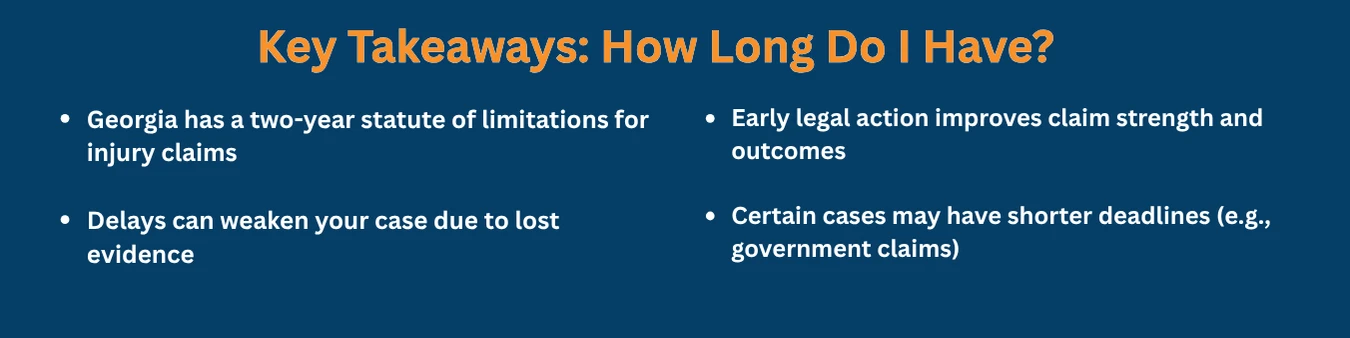
In Georgia, you generally have two years from the date of the accident to file a personal injury lawsuit. For property damage claims, the deadline is four years.
Two years can sound like a long time – but in practice, that window shrinks faster than most people expect. Here’s why acting quickly matters:
Evidence degrades. Skid marks fade. Surveillance video gets overwritten, sometimes within 24 to 72 hours. Physical evidence at the scene is altered by weather, traffic, and cleanup.
Witnesses become harder to locate. People move, change phone numbers, and forget details. The sooner statements are gathered, the more reliable and complete they are.
Medical documentation is easier to build from the start. Gaps in treatment – or delays in seeking care – give insurance companies ammunition to argue your injuries aren’t as serious as claimed.
Insurance companies negotiate differently early on. Once litigation begins, costs increase and timelines extend. Early claims, supported by strong evidence, can sometimes resolve faster and more favorably.
There are also situations that can affect the standard two-year deadline:
- Claims against government entities (e.g., if a city vehicle or road defect contributed to your crash) require an ante litem notice filed within 12 months of the incident – sometimes less.
- Minor victims generally have until their 20th birthday to file (two years after turning 18).
- Death resulting from accident injuries may trigger a wrongful death claim with its own timeline.
Don’t assume you have time to wait. Contact a Duluth car accident attorney as soon as possible to protect your rights.
Duluth, GA Car Accident Statistics and Local Risk Areas
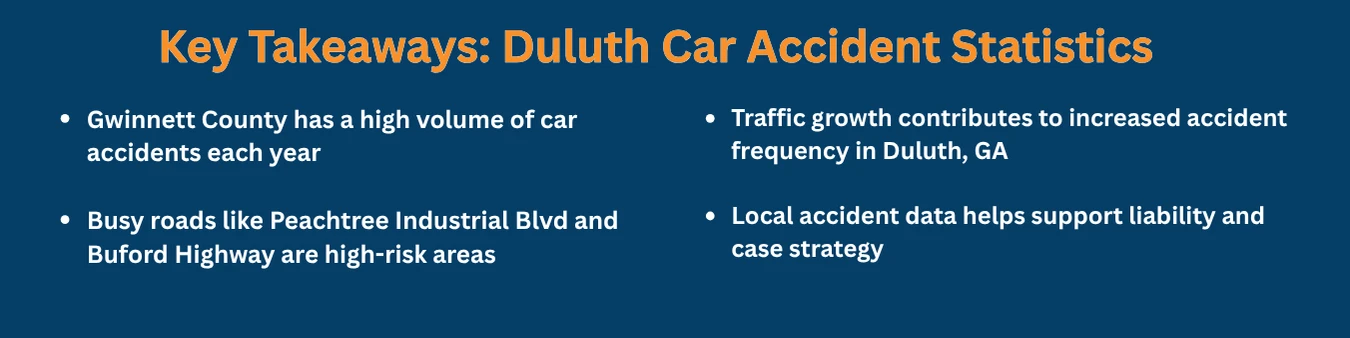
Gwinnett County is one of the most active counties in Georgia when it comes to traffic incidents. The combination of rapid population growth, significant commercial development, and a highway and arterial road network that hasn’t kept pace with demand creates conditions where accidents are a daily reality.
Key facts about traffic safety in Gwinnett County:
- Gwinnett consistently ranks among the top Georgia counties for total vehicle crashes each year
- Distracted driving and speeding are the most commonly cited contributing factors
- Gwinnett County saw significant growth in traffic volume following the COVID-19 pandemic recovery period, with more drivers on the road and a higher rate of aggressive driving behavior reported statewide
High-risk locations in and around Duluth, GA:
- Peachtree Industrial Boulevard – Long stretches of commercial development, frequent lane changes, high congestion near I-285 and I-85 interchanges
- Buford Highway (US-23) – Higher posted speeds, mixed residential and commercial use, pedestrian activity, and intersection density
- Pleasant Hill Road corridor – Heavy commuter and retail traffic; multiple problematic intersections
- State Bridge Road – Growing accident frequency as residential density increases
- SR-120 (Duluth Highway) – Rural-to-suburban transition zones where speed limits change and driver behavior doesn’t always adapt
When you’ve been in an accident at one of these locations, our team can investigate the scene, review available traffic camera footage, pull crash history data for that stretch of road, and – if road design or signaling played a role – identify government entities that may share liability.
Frequently Asked Questions About Duluth Car Accident Claims
Do I need a lawyer after a minor car accident in Duluth?
Yes – and “minor” is a word to be careful with. What looks minor at the scene can turn out to be significant within days. Neck and back injuries, in particular, often don’t reach full severity until 24–72 hours after impact. If you see a doctor and symptoms develop, you’ll be glad you didn’t quickly settle with the insurance company.
Even in smaller claims, a lawyer can protect you from common mistakes – like giving a recorded statement, accepting a lowball offer, or missing documentation that would support your case. A consultation costs you nothing.
How much does a car accident lawyer cost in Georgia?
Scholle Law works on a contingency fee basis. You pay nothing upfront and nothing out of pocket. If we recover compensation for you, our fee is a percentage of that recovery. If we don’t win, you don’t owe us anything. There are no hourly rates, no retainers, and no hidden fees.
What if I was partially at fault for the accident?
You may still be able to recover compensation. Georgia follows a modified comparative negligence standard: if you were less than 50% at fault for the accident, you can recover damages – reduced proportionally by your share of fault.
For example, if you suffered $100,000 in damages but were found 20% at fault, you could still recover $80,000. Insurance companies routinely try to assign more fault to claimants than is warranted. An experienced attorney can push back on inflated fault assessments and protect your recovery.
What if the other driver doesn't have insurance?
Georgia requires drivers to carry liability insurance, but not everyone complies. If the at-fault driver is uninsured – or underinsured relative to your damages – your own uninsured/underinsured motorist (UM/UIM) coverage may step in to cover the gap. Georgia law requires insurance companies to offer UM/UIM coverage, though policyholders can reject it in writing.
If you’re unsure whether you have this coverage or what limits apply, we can review your policy during your free consultation.
How long will my case take?
It depends on the complexity of the case and the seriousness of your injuries. Cases involving clear liability and moderate injuries may settle in a few months. Cases involving severe injuries, disputed fault, multiple parties, or litigation can take a year or more.
One important factor: we generally recommend waiting until you’ve reached maximum medical improvement (MMI) before settling. Settling before your treatment is complete means you may not know the full extent of your long-term costs – and once you settle, you typically can’t go back for more.
We’ll keep you informed throughout the process and won’t push you to settle until the timing is right for you.
Can I still file a claim if the accident happened months ago?
Possibly – but the sooner you act, the better. Evidence is still potentially recoverable, and as long as you’re within Georgia’s two-year statute of limitations, you have the right to pursue your claim. Contact us as soon as possible to assess what options remain available.
What if I was a passenger in the accident?
Passengers injured in accidents can pursue claims against the at-fault driver – whether that’s the driver of the vehicle they were in, the other driver, or both. Passengers are almost never considered at fault for accidents, which often puts them in a strong position to recover full compensation.
The Insurance Company Is Not on Your Side
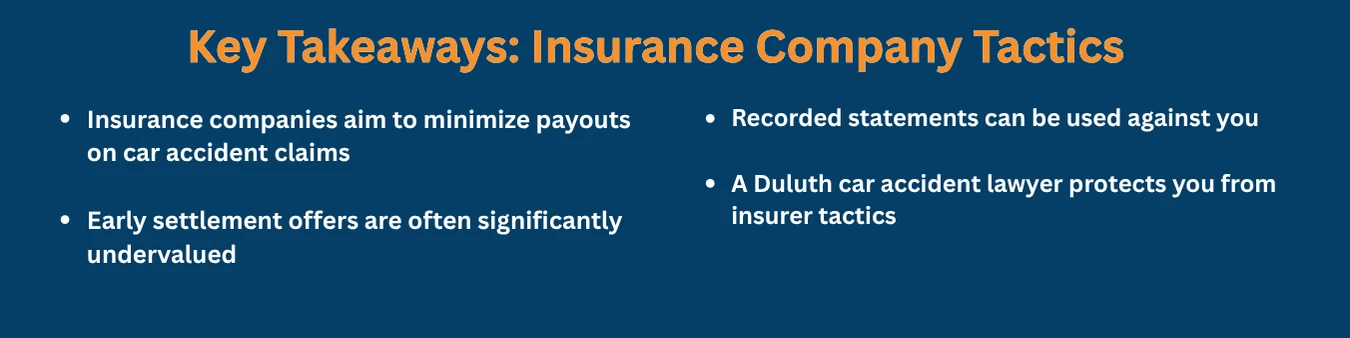
This is worth saying directly: the insurance company representing the at-fault driver has one goal – minimize the payout on your claim. Their adjusters are experienced, their defense teams are well-funded, and they know that injured people often don’t know what their cases are worth.
Common tactics insurance companies use:
- Quick, lowball settlement offers – Designed to close the claim before you understand your full damages
- Recorded statements – Used to capture anything that can be interpreted as minimizing your injuries or admitting fault
- Surveillance – Insurers sometimes hire investigators to photograph or film claimants in situations that can be used to suggest their injuries aren’t limiting
- Delay tactics – Dragging out the process in hopes that financial pressure will force a lower settlement
- Disputing causation – Arguing that your injuries pre-existed the accident or weren’t caused by the crash
When Scholle Law represents you, the insurance company communicates with us – not you. We know their playbook, and we respond to it with evidence, documentation, and a demonstrated willingness to litigate.
The Legal Process: What to Expect from Your Legal Team
Understanding how a car accident claim works in Georgia can reduce anxiety and help you make informed decisions.
1. Free consultation – We review the facts of your accident, your injuries, and your goals. We explain your options and what we believe your case may be worth.
2. Investigation and evidence gathering – We collect police reports, medical records, witness statements, crash scene evidence, and any available surveillance or traffic camera footage.
3. Medical documentation – We work alongside your treating physicians to ensure your injuries are thoroughly documented and connected to the accident.
4. Demand letter – Once your treatment is complete (or your condition is stable), we send a formal demand to the at-fault driver’s insurance company outlining your damages and the compensation you’re seeking.
5. Negotiation – Most cases settle at this stage. We negotiate based on the full documented value of your claim, not the insurance company’s opening offer.
6. Filing a lawsuit (if necessary) – If the insurance company refuses to make a fair offer, we file suit and begin the litigation process. This often increases pressure on the insurer and leads to a better resolution — sometimes before trial.
7. Trial – If a fair settlement cannot be reached, we take your case to a jury trial. Our trial experience means insurance companies know this is a real possibility, not a bluff.
Speak With a Duluth Personal Injury Lawyer Today
You didn’t choose this situation. But you can choose how you respond to it.
The decisions you make in the days and weeks after a car accident in Duluth can have lasting consequences for your financial recovery, your medical care, and your quality of life. Having the right legal team on your side from the beginning gives you the best possible chance of getting what you deserve.
Here’s what happens when you call:
- Free consultation – No obligation, no cost, no pressure
- Case evaluation – We listen to what happened and explain your legal options clearly
- We take it from there – Investigation, documentation, negotiation, litigation if needed
- You focus on recovery – We deal with the insurance company so you don’t have to
Scholle Law has recovered over $100 million for Georgia accident victims. We’ve been doing this for more than 3 decades. We know Gwinnett County, we know the courts, and we know how to fight for the people who trust us with their cases.
Call Scholle Law today at (866) 592-1296 or contact us online to schedule your free consultation. There are no upfront costs, no hourly fees, and no fee unless we win.
Scholle Law serves clients in Duluth, Gwinnett County, and throughout the greater Atlanta metro area, including Lawrenceville, Norcross, Suwanee, Johns Creek, Buford, and Alpharetta.
6340 Sugarloaf Pkwy Suite 150, Duluth, GA 30097